



High-ROI content marketing starts with a simple principle. All you need to do is produce and distribute high-quality resources that align with your audience’s wants and needs.
But the truth is that the way consumers consume content in 2026 is evolving. They constantly expect more — more posts, more value, more entertainment. And delivering on these fronts means that your marketing team needs to perfect the process of scaling content.
The problem arises when more content becomes too much. Increasing output is not impossible. But the trade-off for content marketing teams boils down to quality. And that, inevitably, clashes with the level of excellence your prospects expect from your business.
So, how do you scale content, especially across multiple channels? This guide breaks down practical ways to increase content output while protecting brand consistency, audience relevance, and performance measurement. And is there even a way to do so without losing quality?
This post reviews the best strategies for increasing content marketing outputs, with a strong focus on maintaining superiority.
Highlights
- Reaching your audience requires a strong online presence across multiple channels. In many cases, this may require you to scale your content marketing efforts to achieve success.
- The primary challenge of increased content production is loss of quality. Avoiding it necessitates a strategic approach to scaling.
- To effectively scale content, you need a clear idea of your marketing goals, your target audience’s needs, and the right distribution channels for your business.
- Creating standardized systems and workflows, and tracking core KPIs, can ensure content marketing success — especially during periods of increased activity.
Why you need to scale content

Source: buffer.com
Traditional content marketing advice suggests that brands need to post several times per week (or more, depending on the platform) to optimize for reach and growth. And this might seem excessive. However, in 2026 and beyond, it’s anything but.
According to consumer behavior research, people are spending more time online than ever. And this is particularly true for social media.
According to WeAreSocial’s global digital report, people spend 2+ hours per day on social media, and over 33 hours per week consuming digital content overall.
This trend has several implications.
On the one hand, it shows that competition for consumers’ attention is becoming increasingly fierce, prompting brands to invest more resources to attract and engage their prospects. On the other hand, there’s a very clear limit to how much attention people pay when browsing online resources.
So, if you consider these factors, it’s evident that ramping up content production offers tangible benefits. That said, when you’re just starting to scale, trying to do too much at once can get in the way of actually hitting your content goals.
It’s also worth asking yourself how much of your content prospects remember after closing their tabs/exiting apps. Perhaps their brand and product recall might benefit from increased exposure to your marketing messages.
Furthermore, keep in mind that the sales cycle is constantly lengthening. Moreover, brand discovery is increasingly happening through alternative channels. Considering these, it’s a good idea to explore opportunities to maximize your brand’s reach and credibility off-site, especially on platforms that facilitate brand-customer relationship-building.
The challenges of increased content production

Source: hubspot.com
Scaling your content marketing efforts offers tremendous benefits. Nevertheless, increasing content production in any meaningful way comes with a few significant challenges.
For starters, data suggests that almost one-third of B2B marketers struggle to create enough high-quality content to meet their organization’s needs.
Additionally, greater production may compromise content quality or diminish audience value, especially when significant budget increases don’t accompany it.
It’s also worth considering that content scaling can make it more challenging to stay on schedule or effectively measure ROI.
There’s also the question of rising content production costs, which are inevitable as production scales.
Finally, generating fresh content ideas and maintaining a consistent brand voice can also pose issues — particularly when the changes require expanding your marketing team.
How to scale content across multiple channels
A strategic, goal-oriented approach is key to content marketing success — at any scale. But it’s particularly essential when ramping up production, widening your distribution channels, and expanding your reach.
Even a single wrong step can create a misalignment between the value you put out and the type of resources your prospects seek. So, it’s extremely important to approach the process gradually. Moreover, you need to regularly monitor results to ensure optimal outcomes.
The following are some of the best approaches to scale content across multiple channels without sacrificing quality.
Focus on high-value content that appeals to your audience
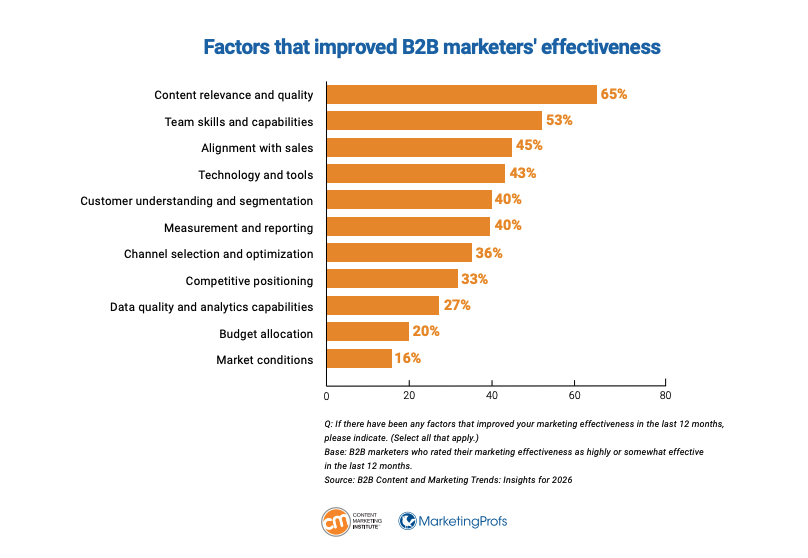
Content relevance is one of the most prominent drivers of marketing success. It’s a key requirement in any digital marketing strategy. And it’s particularly important considering that consumers actively ignore marketing messages that don’t seem relevant to their pain points.
Just look at the research on the factors that drive content marketing effectiveness. You’ll find that 65% of B2B marketers list relevance and quality as the key factors for success.
Source: contentinstitute.com
So, when scaling content for multiple channels, the one thing to maintain is alignment between the value you’re offering and the type of value your ideal customers seek.
Ensure that your content remains high-value, appeals to your target audience, and aligns with the right stages of the buyer’s journey. In doing so, you can maximize engagement and capture more qualified leads who you can then nurture into customers.
There are various approaches to producing high-value content that works across multiple platforms.
For example, you can start by creating in-depth core assets. Such resources are easy to repurpose across multiple channels. And the result is a high-quality content library that doesn’t put too much pressure on your marketing budget.
Check out SellerMetrics. You’ll find that this is exactly the approach the brand takes to keep up with distribution across several channels. Its in-depth blog posts and YouTube videos represent core assets. And the short-form posts on TikTok and Instagram repurpose parts of the brand’s in-depth resources to reach wider audiences.

Source: youtube.com
So, why does this tactic work so well for scaling content marketing efforts? It’s not just because it creates growth opportunities without significantly increasing the production budget. The secret lies in the hyper-relevance of SellerMetrics’ content. It answers the exact questions the brand’s target audience has about data-based Amazon brand growth. More importantly, it’s easily accessible in a way that aligns with how the brand’s audiences browse the internet casually.
Don’t waste your time and budget on irrelevant distribution channels
One of the biggest mistakes brands make when scaling content is thinking they have to be on every content distribution channel.
At its core, this idea isn’t completely wrong. In theory, expanding your online presence should result in higher reach and better brand and product awareness. However, that’s not necessarily the case.

Source: pewresearch.org
According to consumer behavior analyses, different audience segments use different content distribution channels. This hugely depends on their demographic data. But their interests also play a part in how they use various websites — especially social media.
Are you looking to scale your content while maintaining high quality and audience-centricity? Ensure you’re distributing resources on relevant distribution channels.
Research your audience’s behavior. Monitor performance metrics for existing posts. And focus on investing your marketing resources in developing content for high-performing channels.
Check out how Scentbird does it. This brand targets a highly specific audience of fragrance enthusiasts. And it knows where these buyers collect purchase inspiration — mainly through social media, specifically short-form video-based content.
That’s why this brand’s TikTok presence is such a big hit. Its posts are extremely effective at engaging potential shoppers and driving purchase intent. And if you’re still not convinced, just look at the number of views, likes, and comments each post receives. They’re the perfect evidence to show how much it means when you choose the right distribution channels for distributing content.

Source: tiktok.com
Of course, keep in mind that social media isn’t the only distribution channel worth your while — especially when aiming to build brand and product awareness on a large scale. Guest posting can also be an excellent opportunity to reach new leads, particularly by securing backlinks from high-authority publications in your target industry.
Create standardized systems that ensure branding consistency
One of the easiest things to lose when ramping up content production — especially across multiple channels — is brand authenticity.
A higher output inevitably necessitates more work. And it doesn’t matter whether you’re doing it all alone, hiring a dedicated production team, or using advanced tools to meet production goals. What remains the same is that maintaining a consistent brand identity becomes exponentially more difficult at scale.
Now, you may not consider that a big issue. After all, a few inconsistencies here and there can’t do too much harm, right?
Well, that’s the wrong way to look at branding.
According to research, consumers pay very close attention to brand identity. It determines your potential customers’ trust. It affects their ability to recognize your business or products. And research shows that branding consistency even facilitates emotional connection and loyalty. This means it directly impacts your business’s long-term potential for success.
Want to effectively scale branded content across multiple channels? Create standardized systems to ensure branding consistency.
At minimum, this should include channel-specific voice rules, visual guidelines, approval workflows, and examples of approved content formats.
A brand guide will give any member of your content marketing team easy access to information about your organization’s tone of voice, visual identity, and communication styles.
For an example of what this can help you achieve, check out Mesothelioma.net. You’ll discover that the brand has a highly consistent visual appearance across the distribution channels it uses to reach new prospects. For instance, on its YouTube channel, the brand uses a clear color palette and thumbnail style. But if you look at the brand’s homepage, you’ll quickly recognize the same colors and typography, even the same communication style.

Source: youtube.com
The immediate outcome of this type of branding approach is easier brand recognition. Nevertheless, it’s worth noting that this strategy builds credibility and strengthens relationships between the business and its target audience. The result? A deeper sense of familiarity and better conversion outcomes.
Optimize workflows with advanced tools
Content creation tools — particularly AI — are not always capable of delivering high-quality, unique, and customer-centric content. Nevertheless, they can be a good addition to your workflow, especially if you use them for optimizing human-created resources.
Here’s why.
Scaling content can be resource-intensive. Particularly when targeting many distribution channels at once. Producing multiple posts per week (or day) takes time. Plus, it can be expensive.
AI can help teams reduce these challenges — or at least make them easier to manage.
According to Semrush research, 71% of content marketers who use AI rate their efforts as ‘very effective’ or ‘effective.’ Moreover, survey data revealed that AI tools could reduce weekly content production times and cost per article.
Finally, the survey found that 68% of marketers consider the ability to create more content the biggest benefit of implementing AI in the production process. And that goes to show just how effective these tools can be at helping you scale your digital marketing strategy.
To properly optimize workflows with advanced tools and AI, don’t just use them as-is. Instead, use these tools to refine your work.
LLMs are a standard choice for advanced optimization. But they’re not the only solutions that can assist you with your scaling activities. Alternative options include Frase, Grammarly, Hemingway, MarketMuse, and NeuronWriter.

Source: cropink.com
Alternatively, you may use AI tools to maximize engagement on your social media posts by generating relevant imagery. This is a particularly smart strategy if you’re producing a lot of educational resources meant to boost brand authority and earn customer trust.
Look into social media user behavior. You’ll discover that people automatically interact more with Reels and Carousel posts than with text. And this further aligns with how humans process and retain information, with research suggesting that the human brain does much better with visual information than any other format.
For example, take a glance at the Sky & Sol Instagram presence. It perfectly shows how using AI can assist when scaling content. It’s particularly effective at creating supporting imagery for your posts. And it’s a great way to help your audience comprehend information or visualize the benefits your solutions offer.

Source: instagram.com
Keep a focus on your content marketing goals
What’s the biggest mistake marketers make when trying to scale content across multiple channels? It is ramping up content creation across the entire marketing funnel.
In the long run, this may be the way to go. Nevertheless, when just beginning the scaling process, doing too much might prevent you from effectively reaching your content marketing goals.
The problem is that each stage of the funnel needs a different type of content, a different distribution approach, and different metrics. Trying to scale all of them at once spreads your effort too thin, and nothing gets enough attention to actually move the needle.
Do you want to effectively scale content across multiple channels? Go back to your most important content marketing goals. Then invest in resources to help you achieve those outcomes, publishing them one by one to ensure efficacy.
Ask yourself about your most pressing content marketing objectives. Are you trying to broaden audience reach? Boost SEO? Improve brand authority? Elevate conversion rates? Or are you looking to earn customer trust?
Identify a clear content marketing goal for your scaling operations. That way, you can invest time and resources in highly focused content, which is far more likely to succeed than attempting to do too much at once.
For example, check out how Engain implements this tactic. The brand’s YouTube channel is obviously picking up pace. But the content marketing goals it’s going after aren’t spread thin. Instead, the focus is squarely on building product and brand awareness with the right audience. Many of the videos focus on helping people understand the product, which naturally moves them closer to making a purchase.

Source: youtube.com
Scale with intention
The last thing to do when looking for effective ways to scale content is to do so with intention.
This doesn’t just mean staying true to your content marketing goals. It’s also important to verify that your efforts are yielding positive results.
The only way to achieve this is to measure results and adapt your approach as needed.
A good rule of thumb is to track the right content KPIs. See how your approach is working. Give your team access to relevant success-measuring tools. Then make any necessary adjustments to your approach or content strategy to ensure top-notch results.
Final thoughts
Scaling content for multiple channels — especially without sacrificing quality — isn’t simple. But it doesn’t have to be complicated either.
The key to success lies in implementing a strategic approach. This means focusing on consumer value. Choosing the right distribution channels. Developing standardized content creation systems and optimizing your workflows.
Scaling content isn’t about producing more. It’s about building a process that holds up as output grows. The brands that get it right are the ones that treat content as a system, not a one-time push.
Follow these steps to improve your chances of scaling content without sacrificing quality. If your team is producing more but quality is slipping, the answer is to fix the process, not just publish more.
Need assistance with maximizing ROI? Book an intro call with Codeless. Our expert team can help with your strategy and processes, allowing you to take content marketing to the next level.