



Let’s be honest here.
Every marketing plan sounds great on paper until the writing doesn’t deliver.
But strong content writers turn positioning into persuasion. They translate complex ideas into language that your audience understands.
They know how to guide readers from curiosity to confidence to action.
That’s why hiring content writers is a strategic business decision. In this guide, I’m walking you through exactly how to hire content writers who execute your strategy, connect with your audience, and drive real results.
Highlights
- Hiring content writers is a strategic business decision, not just a staffing task — skilled writers translate complex ideas into audience-specific language that aligns with search intent, guides buyers through the funnel, and drives measurable outcomes like traffic, leads, and revenue.
- Before hiring, clearly define your content needs and goals — identify specific content types, topics, target keywords, word counts, publishing frequency, and funnel stages (TOFU/MOFU/BOFU) for each asset, so writers have the direction they need to deliver results from day one.
- A content style guide and detailed briefs are non-negotiable prerequisites — documenting your brand tone of voice, SEO requirements, formatting preferences, and internal linking guidelines ensures consistency across writers and reduces costly revision cycles.
- Choosing between an agency, freelancers, and in-house writers depends on your existing infrastructure — agencies offer full-service production and strategy support; freelancers provide flexibility but require an established SEO strategy; in-house hires make the most sense when internal content operations are already mature.
- Always start with a test assignment before committing to a writer or agency — evaluating a sample piece against a specific brief reveals how well a writer interprets direction, matches your brand voice, and handles research, making it the most reliable indicator of long-term fit.
What are content writers?
Content writers create marketing assets such as SEO blog posts, white papers, email newsletters, landing pages, product descriptions, press releases, social media posts, video scripts, and email templates. They work in-house, at agencies, or they’re freelance writers.
Why hire content writers?
You should hire content writers because they know how to turn ideas into material that reaches the right people.
Some companies also hire technical writers to produce software documentation and detailed product guides that support users and reduce support requests.
They shape messages around your audience, your buyer persona, your goals, and how people search.
This means your content aligns with intent, appears where it should, and reflects the domain expertise your audience expects. Instead of throwing spaghetti at the wall, you get writing built to attract attention, improve Google ranking, guide buying decisions, and support real business outcomes.
TL;DR: Content writers write pieces that line up with search intent, so the right audiences find them.
The cream of the crop: How to hire content writers in 2026
With content marketing, you’re playing the long game. You’re publishing content that can bring in business growth and monthly visitors … forever. Or for as long as your site exists.

This means you need the best content writers on deck. And you need to enjoy working with them for years to come.
Before moving through the steps below, think about what you’d like in a content partner. Weekly check-ins? Kind communication? Content that continues to make your monthly recurring revenue soar?
Keep this in mind as you work the steps below, so you can pick content writers you’ll genuinely like working with.
That said, here’s how to hire content writers in 2026.
Step 1: Get clear on your specific content needs
First, what are your exact content needs?
Use this checklist.
- Outline specific content ideas and topics. Choose a target keyword for each content asset. Pull semantic keywords for each main topic and make sure your writers have access to them. Or supply access via your SEO tool.
Here’s a fantastic SEO topical map by Ahrefs you can reference:

- Choose your content types, order volume, and publishing frequency. E.g., 10 blog posts, four email newsletters, and one white paper, due each month by the 15th.
- Decide on content length. Choose a word count for each piece.
- Outline each content asset’s targeted funnel stage. (TOFO/MOFU/BOFU.)
- Decide whether you need topic-cluster content-writing support. These are pieces for new parent pages and/or child pages.
Also, do you need anything else besides content writing?
Decide if you also need:
- Content for multiple marketing channels like social media, in-app content, and niche communities.
- Content refreshes/updates/rewrites or tear-downs.
- A digital PR strategy (with guest posts).
- An SEO content strategy.
- Content gap analyses.
BTW, if you’re unsure about most or any of these, then you likely don’t have a complete SEO content strategy. (Or you don’t have a strategy at all). No shame. Reach out to the Codeless team for tailored support.
Step 2: Outline your content marketing goals
Why do you need that content?
Define your exact sales funnel goals.
Fill in the blank: “We need content writers …”
- To generate sales qualified leads (SQLs).
- For long-term brand building.
- For digital PR campaigns.
- To convert more SQLs.
- For all of the above.
FYI, if you answered “For all of the above,” you’ll need a full-fledged content marketing plan that supports your entire sales funnel and a link-building strategy.
Next, tie each content asset to one of your goals from above.
For example:
- A blog post titled “What is project management?” is an evergreen cornerstone piece. So the goal would be long-term brand building.
- A comparison guide called “11 project management tools for small teams” is a research piece. So the goal would be to generate SQLs.
- A white paper titled “Best project management software for small teams” is a sales piece. So the goal would be to convert more SQLs.
Here’s an awesome content mapping example by Semrush that shows each piece’s targeted funnel stage:

Finally, decide which writers will best fit your needs.
If you sell B2B software, look for B2B tech and SaaS content writers. Or hire a B2B content agency.
If you’re in ecommerce, look for writers with real online retail experience. Or hire an ecommerce content agency.
If you need news writers and other types of media content, look for documentary writers or journalists.
I highly recommend subject-matter expert (SME) writers for content aimed at mid- or senior-level audiences (such as board members). SME writers are also important if you need health content, medical content, science content, or any kind of B2B content.
Codeless’ writers are highly vetted subject-matter experts. Reach out to book content written by expert writers.
Step 3: Prepare a content style guide and your content briefs
Before you hire writers, you need to set a benchmark for how you’d like your content to sound.
Witty? Sarcastic? Warm? Conversational expert?
Look at other blogs and content assets and analyze their look and feel. What gels well with your brand voice? Which assets look most supportive of the customer journey?
Get inspired by these and write full phrases and examples in your style guide, so writers understand what you’re going for. (Include links to any articles you love so they have a better feel for your expectations.)
In your content creation style guide, make sure to include:
- Existing content on your site that performs well and is aligned with your brand voice
- If you’d like any stats, research, or authoritative external links (hint: yes, you do)
- Any grammar or punctuation preferences (Are you an em dash lover or hater?)
- Instructions about media, like images, graphics, screenshots, or videos
- Example sentences that align and don’t align with your TOV
- Links to any helpful writing tools
- Your brand tone of voice (TOV)
- Your internal linking guidelines
- Your brand colors and logo
- An SEO content checklist
- Anything else you can think of that would make or break the content.
Here’s an example of a style guide template I made in Google Docs to give you an idea:
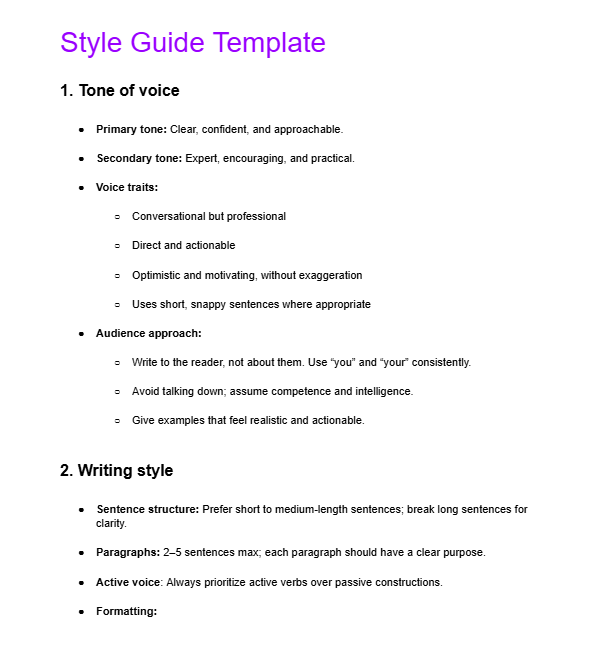
(Image by Ioana)
Next, create content briefs before hiring your writers. (Use the data you pulled from steps one and two to create a content brief for each piece you need.)
In each content brief, include:
- The title for the piece.
- The word count for the piece.
- The funnel stage for the piece.
- The target keyword.
- The business objective.
- The due date.
- A link to your style guide.
- A link to your SEO tool to pull secondary keywords
- Any extra notes you’d like to include (E.g., “No stock images please. High-value screenshots only”)
If you’re also hiring someone to help with content strategy, they can take over the brief building. They can also help you with Steps one and two.
Now that you have the most important information on hand …
Step 4: Decide if you want to hire a content agency, freelance writers, or in-house writers
Time to figure out who’s going to write your content.
You can choose to hire a content agency, freelance writing contractors, or in-house writers. All of these options have benefits and potential drawbacks.
A content agency (a good one) has a whole content production team. They’re smart. They’ve been around for a while. And they have a systematic process that ensures you get high-quality content.
The team members behind your content will include:
- Account managers
- Content writers
- Content editors
- Stagers
And if you also hire them for content strategy (which you probably should), it’ll include SEO content strategists.

There’s very little drawback to hiring a content agency — unless you pick one you don’t like working with. Content collaboration vibes matter.
Freelancers are great because they offer flexibility. You can bring them on to fill in project gaps or work with them on retainer, without having to worry about paying for employee benefits or perks. Plus, if they’re SME writers and have experience, they’ll be damn good.
But it’s best to hire freelancers only if you already have a robust content marketing strategy and an in-house SEO team. Or, look for freelancers with both content strategy and writing experience. (Just make sure they have case studies or testimonials that prove their content has a positive ROI.)
In-house writers are also an option. But again, hiring in-house makes more sense if you already have a solid content strategy and an internal SEO team.
If you choose to go with an agency, Codeless doesn’t disappoint. They’ve got 10+ years of experience and a full content marketing team to support you — from SEO research to content strategy to expert content writing.
You can also try several Codeless writers and pick the one that best suits your brand voice!
Step 5: Look for content writers and start with a test writing assignment
To find agencies or writers for hire, conduct a search on LinkedIn or Google.

➜ Look for positive testimonials, subject-matter expertise, and case studies. Ask for writing samples from sites similar to yours, or check whether they have a published online portfolio.
To make sure it’s a good fit before officially hiring content writers, ask for a test article. Be very specific in your content brief so the writer can do their best to give you what you’re looking for.
Or give them a prompt they can work with.
For instance, if you’re marketing a history blog, you might ask candidates, “How would you write about a hero who’s also accused of war crimes?” And then show them this article on Ronald Speirs as your TOV/style benchmark:

War Criminal Story
Step 6: Hire your content writers
Time to hire your content writers.
If the test piece aligns with your needs, offer to start working with those writers. For a content agency, you’ll likely choose a monthly retainer — and I recommend sticking with them for at least a six- or 12-month contract.
This gives you enough time to see how they communicate, produce content, and what kind of ROI you’re getting.
For freelancers, start with a quarterly run. Then opt for a 12-month contract, or a work-for-hire agreement that never expires.
If you hire in-house, you must use a legally compliant employee compensation model. (Salary, hourly, commission-only where allowed, or a combination, for example.)
Note: Don’t hire content mills. Content mills pay notoriously low rates, and writers may be inexperienced for your marketing purposes. Freelancing sites, like Upwork, also tend to have writers who undercharge or may not be experienced enough for your needs.
Work with the best SME content writers
If you’re looking for content writers with subject-matter expertise who actually give a damn about writing good content, you’ll love Codeless.
Codeless specializes in content writing and has supported major brands like monday.com, ActiveCampaign, Miro, and Freshworks.

If you want to scale your content (and make sure it’s written in your unique brand voice), the Codeless content production team has your back.
With Codeless, you’ll choose how many assets you’d like per month and which writers you want to work with. You’ll also get a complimentary check-in call each month and insights that show the content is performing against your goals.
Wrap up on how to hire content writers
Ready to hire content writers who help you meet business objectives?
Skip the guesswork.
Codeless has expert writers, strategy support, and proven processes to ensure your content reaches your audiences and delivers solid ROI. Plus, the hiring process is super easy. Just book a call, pick your plan, and the team will get started with your content.
Book a call with Codeless now.
You won’t regret it. Promise.
How to hire content writers FAQs
Where can I find content writers?
Search on LinkedIn and Google to find content writers. You can also find them on job boards or via exclusive writing sites with a premium membership. Choose freelance content writers, hire in-house, or work with an agency.
How much do content writers charge?
Rates vary based on experience and niche. General writers cost less. Specialists cost more because they need less direction and deliver stronger content. Expect anywhere from $0.20 to $2.00 per word or project pricing.
Solid content agencies usually charge at least 10K a month.
(Remember, cheap content often means extra edits later and a poor ROI. No bueno.)
How do I write a job description for a content writer?
Be clear and direct. Say what you need, what success looks like, and what types of content they’ll write. Add deadlines and skills expectations, too.
How can I ensure content quality from writers?
To ensure content quality from writers, start with a solid brief. Explain the content asset’s audience, target keyword, tone, and goal. Then give useful feedback instead of vague notes. Clear expectations make good writing easier to repeat.
What questions should I ask in a content writer interview?
Ask content writers how they research, handle edits, and organize big pieces. You want to hear how they think about and manage content. Strong writers talk about process, deadlines, and feedback without hesitation.
And the best of the best also talk strategy.
How long does it take to hire a good content writer?
It usually takes a couple of weeks to hire a good content writer. (You’ll need to review samples, test assignments, and conduct interviews. Or meet to talk about research and strategy first.)
Can I hire content writers remotely?
Yes, you can hire content writers remotely. Most great writers work remotely already. Just make sure to hand them clear briefs, provide access to relevant tools, and stay in communication to keep everything running smoothly.