



Competition in financial services SEO is fierce, especially for smaller brands trying to compete with established publishers. The landscape is dominated by big names like NerdWallet, Bankrate, and all the big banks. At the same time, zero-click search makes generic keywords less reliable for smaller brands competing against established financial publishers.
Improving organic traffic and digital visibility under these conditions requires a strategic shift:
- You can’t rely on broad head terms that burn through marketing budgets while delivering minimal returns
- You need a specialized, targeted approach to surround the big players
Reading this guide reveals how to bypass giant competitors by mastering entity coverage. You’ll learn to establish topical authority in specific niches to capture qualified traffic.
Highlights
- Building topical authority in finance SEO requires mastering a surround strategy to dominate niche entities instead of battling legacy publishers for broad head terms.
- Boost credibility by demonstrating E-E-A-T through credentialed author profiles and subject matter experts.
- Uncover high-value backlink opportunities by analyzing SERPs with advanced search operators.
- Target BOFU content to capture ready-to-convert users and drive measurable lead generation.
The need for an alternative finance SEO strategy
Traditional SEO strategies take time to show results. This is even more true in highly competitive industries like finance. But if you do things right, craft good content in the right format, and you’re sure you’ll see those results sooner or later.
However, the landscape has changed (Yes! It’s because of AI). Now, time is against you.
SparkToro data shows that in 2026, 68% of Google searches ended without a click, nearly 10% higher than in 2024. Over a quarter of the remaining searches, the ones with clicks, went to Alphabet-owned sites. In the end, of every 1,000 US searches in early 2026, only 232 went to the broader web.

(Google search behavior in 2026 vs. 2024. Image created by author. Data source)
This data shows that traditional financial SEO strategies are delivering less traffic than they once did. You can’t afford to pour thousands into a strategy that may not generate enough ROI anytime soon.
You need an alternative action plan that prioritizes measurable SEO performance. The following strategies show how to build one.
Strategy 1: The surround strategy for YMYL niches and building topical authority
Competing head-to-head with legacy publishers exhausts resources. Today, financial institutions and fintech companies win by going wide and deep on specific financial entities rather than chasing generic terms. Building a web of niche content helps you secure vital real estate across answer engines.
This surround strategy positions you as the definitive source for complex topics. It drives revenue faster than chasing generic terms. For example, NerdWallet’s Q4 2024 performance showed a 37% revenue increase despite experiencing a 20% traffic drop in unique monthly visitors. These numbers show why traffic volume alone doesn’t tell the full story. Finance brands also need to consider whether their visibility is actually attracting users with genuine commercial intent.
Owning a narrow category sends stronger relevance signals to search algorithms. A surround strategy does this by selecting one commercially relevant financial topic and addressing the informational, comparative, regulatory, and transactional questions surrounding it. You build trust by going deeper on the details that larger publishers tend to skip over.
The steps below show how to build that kind of coverage while keeping the expertise and compliance standards financial content requires.
Demonstrating E-E-A-T through subject matter experts (SMEs)
Search engines apply maximum scrutiny to finance because it falls within the ‘your money or your life’ category. You must prove your expertise by spotlighting credentialed authors within your content architecture. For each author, you must:
- Display their professional certifications, like CPA or CFA, alongside their published articles
- Highlight their practical experience and active industry involvement
Robust author bio pages signal expertise, authoritativeness, and trust to crawlers and human readers alike. They elevate your brand credibility and satisfy strict E-E-A-T guidelines. Tying your insights to verifiable human experts creates a defensive moat around your content.
Navigating regulatory compliance and FINRA/SEC regulations
Publishing financial content requires balancing production speed with legal oversight. Build compliance reviews into your content process early to avoid bottlenecks later. For example, you must:
- Establish pre-approved language templates to accelerate your workflow
- Use clear disclaimers for promotional claims to maintain fairness
- Clearly separate educational material from promotional content
- Maintain an organized audit trail of edits for future compliance
This proactive approach helps satisfy FINRA and SEC regulations while keeping disclosures and privacy policies aligned with the broader content process. Compliance teams serve as partners when integrated early into the planning phase. Early collaboration ensures your strategic SEO goals survive the legal review process.
Strategy 2: Structuring financial content with the pillar-cluster model
A flat website architecture confuses search crawlers and dilutes your relevance. Organizing your pages around a content pillar-cluster model establishes a clear, logical hierarchy. This structure proves to search engines that, as a financial institution, you own entire subject areas.
A successful setup features:
- A comprehensive pillar page that covers the core questions surrounding a broad topic such as ‘small business banking
- Multiple deeply specific supporting subtopic clusters discussing merchant services and cash flow tools
- Internal linking that connects these pages bidirectionally to pass authority throughout the cluster

(Example of a pillar-cluster content model. Data source)
Conducting keyword research for specific long-tail keywords
Building this architecture starts with finding the right topics to cluster. A dense web of interconnected, specific subtopics builds topical authority. Keyword research and an SEO audit can help you uncover long-tail terms, content gaps, and existing content that requires deeper technical coverage
When you transition from generalist advice to higher-quality technical analysis, you provide the functional utility users need to make decisions. For example, instead of talking broadly about market recovery, break down bullish chart patterns in detail.

(Ascending Triangle pattern showing a bullish consolidation before a breakout. Data source)
Covering a pattern like an ascending triangle lets an investment platform show real technical knowledge rather than recycling general market commentary. It also speaks to users who have moved beyond the basics and are seeking specific analytical guidance.
Linking that resource to related pages on reversal patterns, continuation patterns, volume confirmation, and risk management builds a coherent topical network. That network gives search engines clearer evidence of depth while helping readers continue their research naturally.
Mapping search intent to BOFU content for your target audience
High-intent users require precise guidance to take action. Aligning your articles with the buyer’s journey stage captures customers. Map search intent to BOFU content for your target audience by identifying the decision behind each query.
Separate queries by the decision they help users make. Informational pages should cover the basics and terminology. BOFU should cover eligibility, comparisons, costs, documentation, and next steps.
For example, mortgage preapproval is one of those moments where users are moving toward action, not just researching. You can create content in a way that matches real user intent by addressing:
- Financial readiness
- Eligibility
- Timing
It also connects to related topics to build out your cluster, including:
- Income verification
- Credit scores
- Loan options
This cluster signals depth to search engines. So, instead of competing on general finance terms, you build authority around the decisions people are making.
Creating thought leadership in B2B finance and wealth management
Owning a nuanced market segment builds a defensive moat against generalist publishers. One way to accomplish that is to establish thought leadership in B2B finance, fintech, and wealth management by leaning into complexity.
The life settlement market is a textbook example of a finance niche where competing on head terms like “life insurance” is next to impossible for the underdog. However, building genuine topical authority within a specific market segment is achievable.
For example, you can create thought leadership content around complex topics like:
- Legal compliance for broker-dealers in the secondary life insurance market
- Calculating life expectancy for institutional investors in life settlements
- Life settlement vs. viatical settlement for terminally ill policyholders
- Tax implications of life settlement for irrevocable trusts
Strategy 3: Preparing for Answer Engine Optimization (AEO) and zero-click search
Generative AI changes organic search from securing clicks to securing citations. This is critical for YMYL topics like finance, because:
- Google’s AI Overviews (AIOs) increased their appearance in search to an average of 20.5% of SERPs as of November 2025 (source: Ahrefs)
- However, they’re more prevalent in YMYL topics, showing up in 22.9% of SERPs for financial keywords
- AIOs reduce CTR by up to 58% (source: Ahrefs)
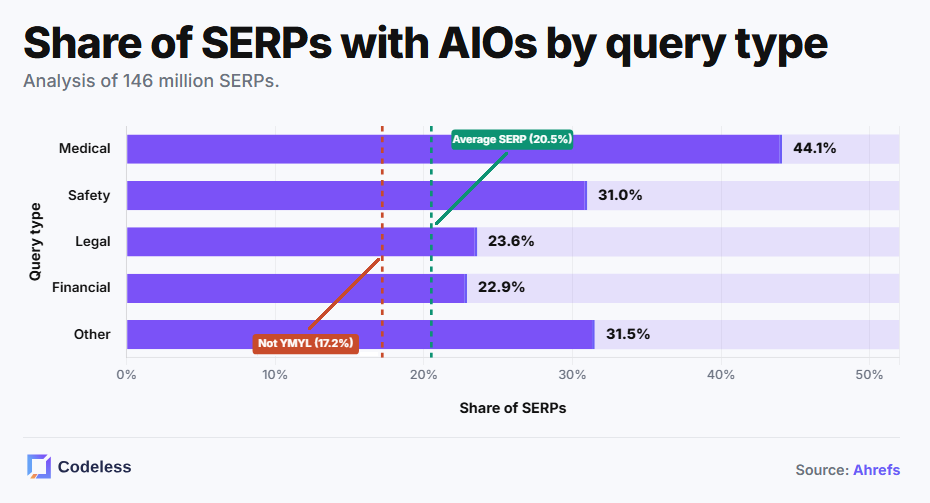
(SERPs with AI Overviews for YMYL Queries, According to Ahrefs. Data source)
That’s why your content strategy needs to move toward Answer Engine Optimization (AEO), not just SEO.
Implementing technical SEO and structured data/schema markup
Technical SEO removes barriers that prevent bots from crawling and indexing your pages correctly, while improving the user experience. You enhance this baseline visibility by deploying structured data and schema markup across your site.
For example, applying schema types such as FAQPage, FinancialService, and Person connects your authors and services to Google’s broader Knowledge Graph.

(Structured data connects page content with machine-readable entities. Data source)
This is part of AEO’s broader strategy, called entity mapping. This strategy involves identifying those “nodes” or “entities” related to your brand and organizing how your pages map to them. For example, you decide that:
- Page A is about the FinancialService entity
- Page B is about the Person entity
- Page C is an FAQPage entity
- And so on
Structured markup helps search systems tell apart your authors, services, organizations, and content types. Clearer entity structure can improve how machines interpret your site, though schema alone doesn’t guarantee citations or inclusion in AI Overviews.
Leveraging local SEO and your Google business profile
Location-based queries represent an opportunity to bypass large national competitors. You can reach high-intent prospects by using local SEO to target regional financial searches. Mobile voice searches also heavily favor local intent.
A financial advisor, wealth manager, or branch manager should optimize their Google Business Profile to attract nearby clients. Consistent business citations across directories build local authority and help boost AEO.
Strategy 4: Link building: Analyzing SERPs to find backlink opportunities
Off-page tactics should remain part of a broader white hat SEO strategy for finance brands. For large brands, this is easy:
- Large brands with high DR sites that already rank grow their backlink profiles organically
- Smaller brands must actively prospect for citations
You can unlock value by executing targeted link-building campaigns based on competitor data. Analyzing SERPs helps you steal link share from other publishers.
Reverse engineering the head term winners
Competitors like NerdWallet own the top spots for generic, high-volume keywords. Each top result garners thousands of backlinks. You can reverse engineer these head term winners by running their ranking articles through a backlink checker. This tactic reveals the exact referring domains sending authority to your direct competitors.
The next step is getting cited on those referring domains. Here’s an effective action plan to accomplish that:
- Find out who the target domain’s content editor is. You can do a site search using terms such as “editor,” “head of content,” “content strategist,” etc.
- Find their contact information. Their email is a must, but LinkedIn profiles are also a good channel for cold outreach.
- Pitch them with your highly specific BOFU content as a high-value alternative.
The process of identifying these opportunities involves careful vetting for relevance. The takeaway is to consistently build a curated list of high DR linking domains that drive real authority to your content.
Scraping SERPs with advanced search operators
You can also find potential backlink sources by scraping SERPs with advanced search operators. Combine specific long-tail keywords with operators like:
- inurl:”weekly roundup”
- inurl:newsletter
- inurl:resources
This reveals websites actively seeking external financial resources and helps financial services companies identify relevant outreach opportunities. Reach out and offer your niche content as a valuable addition to their resource pages.

(Google search operators uncover outreach opportunities. Data source)
Using news SERPs for digital PR and SME pitching
Journalists frequently need expert commentary for breaking financial stories. You tap into this demand by using news SERPs for digital PR and SME pitching. Search your niche in Google News to find writers covering recent market shifts.

(Google News helps find finance journalists. Data source)
Pitch your credentialed experts to these journalists to earn high-authority media citations:
- An expert quote gives the reporter relevant commentary for the story
- The resulting citation can earn your site a natural, authoritative link
Outsourcing backlink acquisition to a specialized agency
Following the previous link-building strategies is hard work:
- Link acquisition in the financial sector demands strict compliance and careful relationship management
- Managing outreach campaigns diverts resources away from actual content creation
Outsourcing backlink acquisition to a specialized agency solves this bandwidth issue. It makes financial sense when your in-house team lacks the time to foster media relationships.
Even an underdog can drive positive ROI with finance SEO
The strategies above show that small brands can succeed in finance SEO. It’s about developing niche topical authority in areas where big publishers slack. The strategy is less about keyword targeting and more about entity coverage. That means:
- Building credentialed author profiles
- Creating content that answers the specific questions the big players miss
- Structuring content with structured data and schema markup so search engines and AI models can understand it
- Mapping search intent to specific financial entities to ensure LLMs can accurately cite your content
- Building links from the same authoritative, high-DR sites referencing your competition
This focused content SEO strategy builds trust, answers questions, and generates qualified leads. Operationalize your content production and scale your financial clusters today with predictable, fixed-price monthly subscriptions from Codeless.
FAQs
How long does it take to see results from finance SEO?
Financial services campaigns typically require four to six months to generate meaningful traffic. Building substantial lead flow often takes nine to twelve months due to longer decision cycles. This extended timeline reflects the complex trust-building required for YMYL topics.
Why is E-E-A-T more important for financial websites?
Inaccurate financial content poses severe real-world risks to consumers and their financial stability. Google holds these pages to a higher standard of quality to protect users from harmful misinformation. Search engines demand rigorous proof of expertise before ranking any financial advice.
Can smaller financial firms outrank legacy banks?
Smaller brands win by targeting highly specific, long-tail queries. Establishing deep topical authority within a narrow niche bypasses the need to fight for broad terms. Focused entity coverage consistently outperforms generalized banking content.